
Subtotal ₹0.00
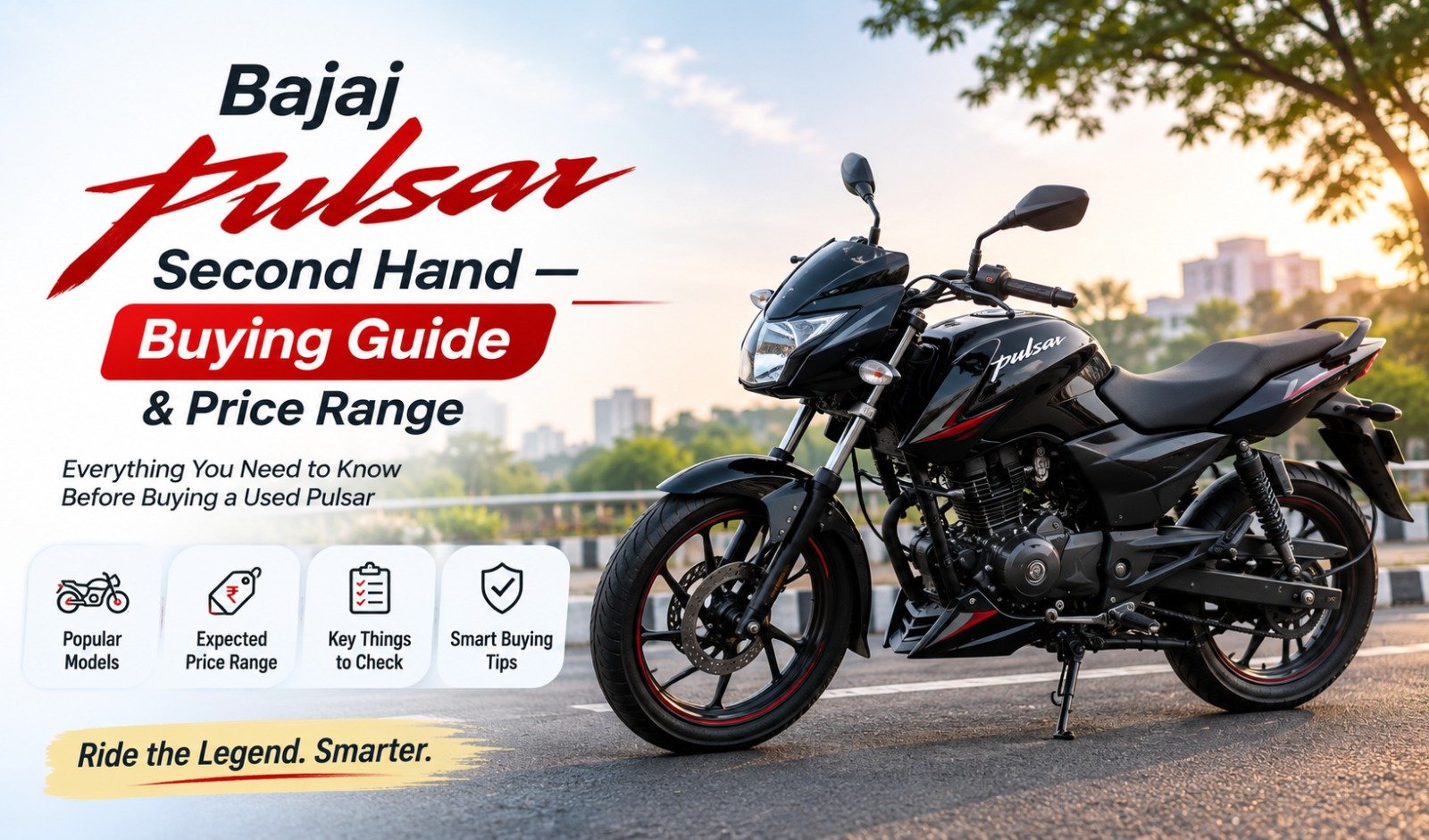
If you’ve ever asked five different bikers which second-hand motorcycle to buy under a lakh, at least three of them probably said “Pulsar.” There’s a reason for that. The Bajaj Pulsar has been India’s go-to first performance bike for over two decades, which means the used market is massive — thousands of listings across every city, every budget, and every condition imaginable.
That’s also exactly why buying one needs a bit of homework. A good used Pulsar can give you years of reliable riding at a fraction of the showroom price. A bad one can turn into a monthly trip to the mechanic. Here’s everything you need to check, negotiate, and paper-work your way through before you hand over the cash.
Why the Pulsar Still Dominates India’s Used Bike Market
Three reasons keep the Pulsar at the top of resale searches:
- Spare parts are everywhere. Every mechanic from a metro city to a small town knows the Pulsar inside out, and parts are cheap and easy to find.
- Engine options for every From the fuel-friendly 125cc and 150cc commuters to the punchier 180, 200, 220F and NS/RS performance variants, there’s a Pulsar for every budget and riding style.
- Strong resale Because demand never really dips, a well-maintained Pulsar holds its value better than most bikes in its segment — which also means it’s worth buying right rather than buying fast.
Second-Hand Bajaj Pulsar Price Guide (By Model)
Used bike prices swing a lot based on city, kilometers run, number of owners, and how well the bike has been maintained — so treat these as ballpark ranges rather than fixed numbers. As a rough guide based on current listings across major Indian cities:
Model | Typical Used Price Range | Notes |
Pulsar 125 | ₹40,000 – ₹95,000 | Best value commuter; low running cost |
Pulsar 150 | ₹28,000 – ₹90,000 | Widest supply, easiest to find and resell |
Pulsar 180 | ₹35,000 – ₹75,000 | Mostly older stock, check emission-norm compliance |
Pulsar 200 RS / NS200 | ₹65,000 – ₹1,49,000 | Price depends heavily on year and ABS variant |
Pulsar 220F | ₹75,000 – ₹1,25,000 | Faired variant holds value well if bodywork is intact |
Pulsar N160 / N250 (newer) | ₹90,000 and above | Recent models, still depreciating fast in year one |
A rough rule of thumb: a Pulsar loses the most value in its first two years, then depreciation slows down and stabilizes if the bike has a clean history and low kilometers per year (under 8,000–10,000 km/year is considered healthy).
What to Physically Check Before You Buy
Don’t rely on how the bike looks in photos or how it sounds when someone else revs it. Insist on checking these yourself, ideally in daylight:
Engine and chassis number matching The engine number and chassis number stamped on the bike must exactly match what’s printed on the RC (Registration Certificate). This is the single most important check — a mismatch usually means a stolen or illegally re-registered vehicle, and no amount of “it’s just a typo” explanation should convince you otherwise.
Engine health Start the bike cold. A well-maintained Pulsar should start smoothly without excessive cranking, settle into an even idle, and not blow visible smoke from the exhaust. Blue-ish smoke usually points to oil burning; black smoke suggests a carburetion or fuel-injection issue.
Chain, sprocket, and brakes A loose, rusty, or overly tight chain signals neglect. Worn-out sprocket teeth (they’ll look shark-fin shaped instead of straight) mean a replacement is due soon — factor that into your negotiation.
Frame and panels for accident history Run your hand along the frame near the headlight mount and foot pegs for weld marks or uneven paint. Mismatched panel colors, overspray on rubber parts, or panel gaps are giveaways of past accident repair.
Tyres and suspension Check tyre manufacturing date (stamped on the sidewall) — old tyres crack even with low usage. Push down on the front forks and rear shocks; they should rebound smoothly without a clunking sound.
Service history Ask for the service booklet or invoices from an authorized Bajaj service center. A documented history is worth paying a bit more for, since it tells you the bike wasn’t just running on “as and when needed” repairs.
Test ride Ride it on a stretch with a pothole or two, take it above 60 km/h briefly, and brake hard once (safely). Listen for knocking sounds from the engine and check if the bike pulls to one side under braking.
Documents You Must Verify Before Paying
This is where a lot of buyers get careless — and where most used-bike disputes in India come from.
- Original RC (Registration Certificate) — confirm it’s the original, not a photocopy, and that the owner’s name matches the person selling it to you.
- Insurance policy — check it’s valid, and note whether it’s third-party only or
- PUC (Pollution Under Control) certificate — should be current; you’ll need a valid one to legally ride the bike and to renew
- Loan/hypothecation clearance — if the RC shows a bank’s name under “hypothecation,” get a No Objection Certificate (NOC) from that bank confirming the loan is fully closed, before you pay
- Form 28, 29, and 30 — these are the RTO forms needed for ownership transfer (NOC, notice of transfer, and application for transfer of ownership). Make sure the seller signs these at the time of
- Address/state matching — if you’re buying from another state, you’ll additionally need a re-registration NOC from the original RTO before you can register the bike in your own state.
Don’t skip the RC transfer paperwork even if the seller says “usually people just ride it, no need to transfer.” Any unpaid challans, accidents, or legal issues linked to the bike will remain the previous owner’s problem only if the transfer is done properly — otherwise, they can come back to you.
Common Red Flags to Watch For
- Odometer readings that don’t match wear. A bike showing 8,000 km but with worn-out pedal rubber, faded switches, and a scratched fuel tank has probably had its odometer rolled
- Seller isn’t the RC owner and can’t explain Always ask to see ID proof matching the RC.
- Too-good-to-be-true pricing. A Pulsar priced well below the going rate for its model and year is worth being cautious about — verify everything twice before paying any advance.
- Reluctance to do a proper test ride or let you check the engine/chassis A genuine seller has nothing to hide here.
- Pressure to pay a “token amount” Take your time. A rushed sale benefits the seller more than you.
Where to Buy With More Confidence
Buying second-hand doesn’t have to mean crossing your fingers and hoping for the best. On Winloo, listings come with clearer bike history and details upfront, so you spend less time chasing sellers for basic information and more time actually deciding if the bike is right for you. It’s still worth doing your own physical inspection and document checks (never skip those, no matter how the listing looks) — but starting from a more transparent listing saves you a lot of the usual back-and-forth.
Frequently Asked Questions
Is buying a second-hand Bajaj Pulsar a good idea?
Yes, for most riders it’s a solid choice — parts are cheap and widely available, mechanics know the bike well, and resale value stays reasonably strong if you maintain it. The key is checking the specific bike’s history and condition rather than judging the model in general.
Which second-hand Pulsar model offers the best value for money?
The Pulsar 150 usually offers the best balance of price, fuel efficiency, and parts availability, since it has the widest supply in the used market. If you want more power, the NS200 or 220F hold their value well but sit at a higher price point.
How do I check if a used Pulsar has a clean ownership history?
Match the engine and chassis numbers against the RC, confirm the seller’s ID matches the RC owner’s name, check for any hypothecation (loan) entry on the RC, and ask for service records. You can also verify challan and ownership history using the RC number on the Parivahan (mParivahan) portal.
Do I need to transfer the RC immediately after buying a used Pulsar?
Yes, you should complete the RTO ownership transfer as soon as possible after purchase. Riding on the previous owner’s RC leaves you both exposed — any pending challans, accidents, or disputes linked to the bike could otherwise become harder to resolve cleanly.
What is the average resale value drop for a Bajaj Pulsar after 5 years?
Depreciation is steepest in the first two years, after which it slows down. A well-maintained Pulsar with average yearly usage typically retains 40–55% of its original showroom price at the five-year mark, though this varies by model and condition.
Have a specific Pulsar model or budget in mind? Browse verified listings on Winloo to compare prices and history side by side.


Comments are closed